

Why the next great energy storage brand will be designed in India, engineered for Indian conditions and accountable to Indian customers
India spent more than 3 billion US dollars importing lithium-ion batteries in 2024-25. More than 85 percent of them came from one country.
That is not a trade statistic. That is a dependency.
Every home inverter upgrade, every rooftop solar battery, every electric scooter and every commercial backup system we install adds to it. And the conversation around "Make in India" batteries has mostly been about one thing: building giant cell factories. That matters. But it is only one part of the story, and for the customer standing in a server room, a clinic or a factory floor, it is not even the part that decides whether the lights stay on.
This article is about the other part. The part that decides whether a battery system actually works in India, lasts in India and gets fixed in India when something goes wrong.
QUICK ANSWER
A battery system is "Indian" in the way that matters to you when its design, its engineering choices, its intelligence and its accountability live in India. Cells are one layer out of seven. The thermal design, the Battery Management System, the power electronics, the integration, the software and the service network are where performance and trust are actually created. PuREPower is designed, developed and manufactured in India across the full range from 3 kVA to 120 kVA.
Let us start with the facts, because this subject deserves facts, not slogans.
According to the 2026 technical review "Global Energy Storage Systems: A Critical Technical Review" by the Grid Integration Lab at IIT Bombay, prepared under the MNRE and GIZ StoREin programme, global lithium-ion battery production grew from about 1.6 TWh in 2024 to 2.3 TWh in 2025. China accounted for roughly 86 percent of it. In LFP related supply chain segments, China's dominance exceeds 98 percent.
India's own numbers tell the same story from the other side. IEEFA estimates that India's lithium-ion import bill rose roughly eightfold, from about USD 384 million in FY 2018-19 to more than USD 3 billion in FY 2024-25, with China supplying more than 85 percent of those imports.
The same IIT Bombay review makes a point that most people miss. Supply dependence is driven more by processing and conversion than by mining. In other words, the choke point is not only who owns the lithium in the ground. It is who controls the chemistry, the refining, the cathode and anode materials and the know-how to turn them into reliable products.
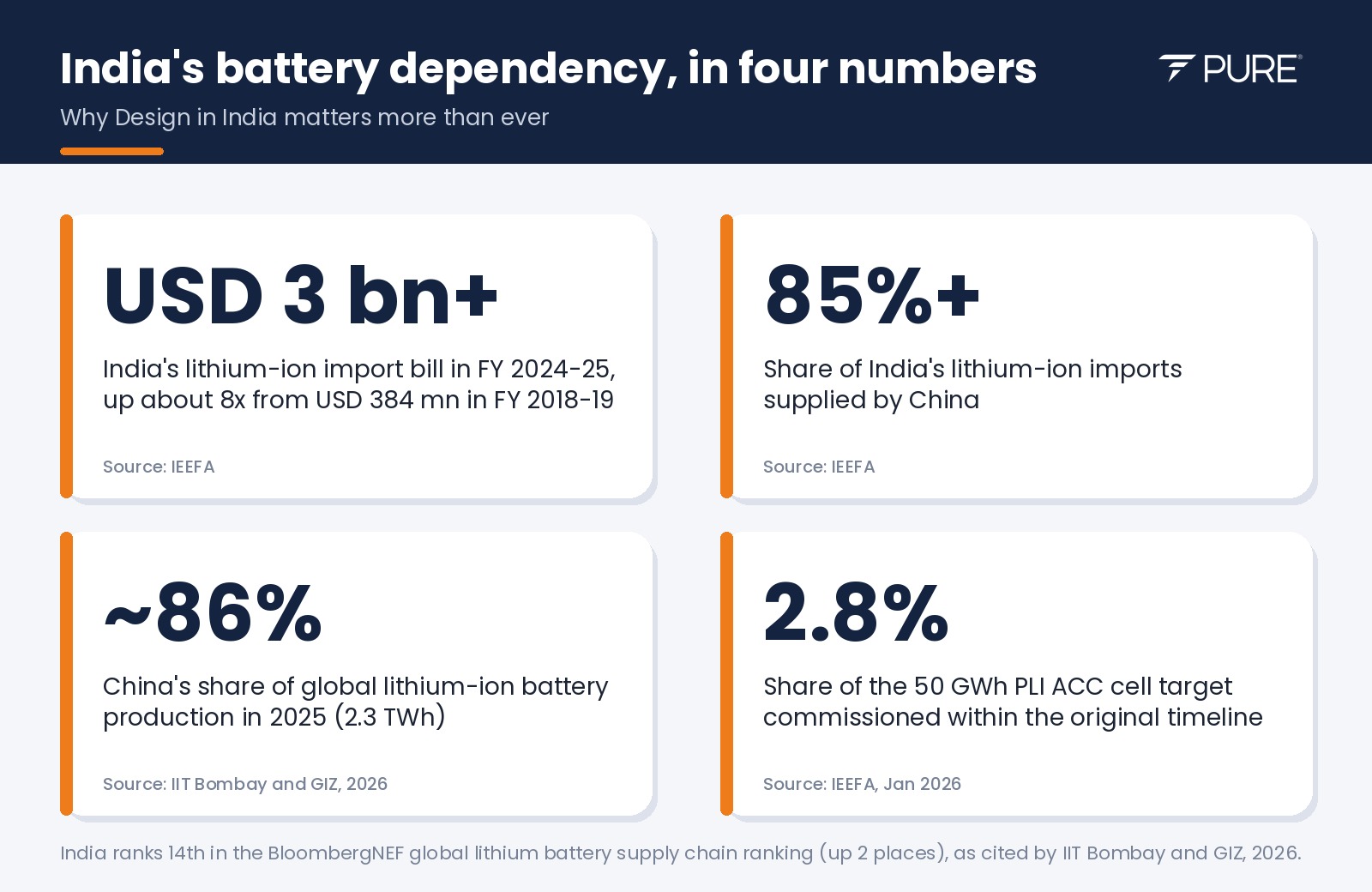
India's answer at the policy level has been the Production Linked Incentive scheme for Advanced Chemistry Cell battery storage. It was launched in 2021 with an outlay of ₹18,100 crore to build 50 GWh of domestic cell manufacturing.
It is an important scheme. But IEEFA reported in January 2026 that only about 1.4 GWh, around 2.8 percent of the targeted capacity, had been commissioned within the original timeline. Cell manufacturing at scale is hard, capital heavy and slow. It will come, and when it comes, Indian brands like ours will be among the first to benefit.
Here is the honest part. Today, almost every Indian energy storage brand, including PuREPower, sources its lithium cells from established global Tier-1 cell makers. Anyone who tells you otherwise should be asked for the cell factory address.
So if the cells are global, what exactly makes a battery system Indian?
The answer is everything that happens after the cell. And that is where most of the value, most of the risk and almost all of your experience as a customer is decided.
A cell is a raw ingredient. By itself it cannot start an air conditioner, survive a Rajasthan summer, talk to your solar panels or tell you on your phone that your battery is healthy. A battery energy storage system is a stack of seven layers, and each layer is a design decision.
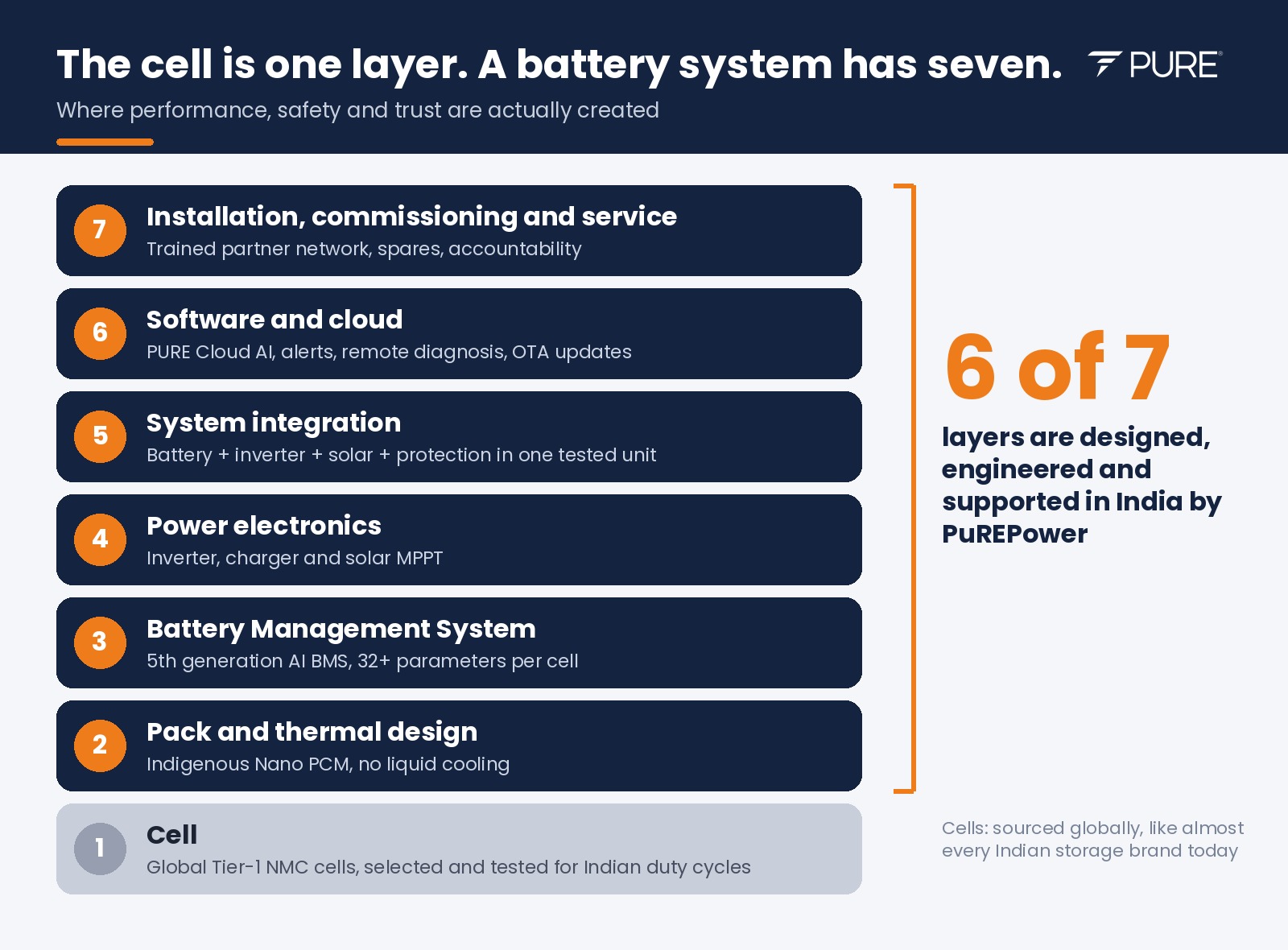
Six of these seven layers are not about where the cell was made. They are about who designed the system, for which conditions, and who stands behind it. That is what "Design in India" really means.
India is not a mild-climate market with a gentle load profile. A battery that works beautifully in a German basement can struggle in a Hyderabad utility room. Designing in India means designing for four hard realities.
Large parts of India see ambient temperatures of 40°C to 50°C in summer, and cells inside a closed enclosure run hotter still. Utility-scale projects solve this with liquid cooling, chillers and pumps. That is simply uneconomical for a 3 kVA home unit or a 60 kVA commercial unit.
PuREPower's answer is an indigenous Nano Phase Change Material (Nano PCM) built into the battery modules. It absorbs heat during high-load events and releases it slowly, passively, with no pumps, no compressors and no moving parts to fail. Over more than seven years of field deployment across some of India's hottest states, we have recorded zero thermal incidents.
An air conditioner compressor, a lift motor or a submersible pump can draw three to five times its running current for a moment when it starts. This is the load profile that kept diesel generators alive in India for decades.
This is one reason PuREPower chose NMC chemistry across the entire range. NMC delivers high power quickly, handles surge loads natively and packs more energy into a smaller footprint. We explain the full engineering reasoning in our detailed analysis of NMC over LFP for Indian conditions. There is also a supply chain angle worth noting. The IIT Bombay review observes that while LFP segments are overwhelmingly concentrated in one country, other regions retain strengths in parts of the NMC ecosystem. A more diversified chemistry is a more resilient chemistry.
Most Indian power cuts in homes and businesses last 30 to 90 minutes and can happen several times a day in summer. That calls for a battery that delivers high power for short durations and recharges quickly between cuts. It is why our range is designed around a roughly 1:1 ratio between kVA rating and kWh capacity, and why switchover has to be fast enough that computers and machines do not notice.
Indian sites are diverse. The same week, a dealer may install a unit in a 3BHK flat, a dental clinic and a textile unit. A system that depends on perfect site wiring and perfectly matched components from three vendors will fail somewhere. That is why PuREPower builds the battery, inverter, solar controller and protection into one factory-integrated unit, tested as one system before it leaves the factory. We explain why site-assembled configurations underdeliver in this detailed post.
If the cell is the muscle, the Battery Management System is the brain. PuREPower's BMS is now in its fifth generation, designed around NMC chemistry and Indian operating conditions. It monitors more than 32 parameters per cell, predicts imbalance before it becomes damage, manages surge delivery dynamically and adjusts charging to real-time cell temperature.
Above the BMS sits PURE Cloud AI. It watches every connected system, sends plain-language alerts, supports remote diagnosis and delivers firmware improvements over the air. When our engineers learn something from a site in Jodhpur, every customer in Chennai can benefit from it.
This is the part of "Make in India" that rarely makes headlines. Intellectual property. PuREPower was incubated at IIT Hyderabad, has more than a decade of R&D behind it and has filed more than 120 intellectual property applications. Every one of them is a design decision made in India, for India.
Patriotism is a good reason to feel proud. It is not a good enough reason to spend lakhs of rupees. So let us be practical. Here is what a genuinely designed-in-India system changes for the person who pays for it.
| What you should compare | Imported box, locally badged | Designed and built in India |
|---|---|---|
| Who designed it for Indian heat and surge loads | Designed abroad for other markets | Designed around Indian duty cycles from day one |
| Who can change the firmware when a problem appears | Overseas supplier, on their timeline | Indian engineering team, pushed over the air |
| Spares and replacement modules | Depends on the next container | Stocked and supported within India |
| Warranty accountability | Often limited to the reseller | The manufacturer, directly |
| Integration of battery, inverter and solar | Frequently mixed brands on site | One factory-integrated, factory-tested system |
| Service and I&C | Varies by dealer | Trained partner network with a common standard |
The biggest difference is accountability. A 10-year or 12-year battery warranty is only as good as the company that stands behind it for 10 or 12 years. PuREPower offers a 5-year standard warranty, extendable up to 12 years, and we can offer it because the design decisions that determine the battery's life were made by us.
For distributors, dealers and service partners, a designed-in-India product is also a better business.
PuREPower is already onboarded on PM Surya Ghar, BEE and GeM, and supported by a growing network of more than 100 dealers across Tier-2 and Tier-3 India. If you want to build that business in your region, you can start with a dealership enquiry here.
The label is easy to print. Here are seven questions any buyer, consultant or procurement team can ask before signing a purchase order.
A manufacturer who designs in India will answer these in one meeting. That, more than any sticker, is the proof.
India will build its cell factories. It must, and it will. But the country does not need to wait for them to have world-class energy storage that is designed here, engineered for our conditions and supported by people who will still be here in 12 years.
Make in India is not a sticker on the box. It is the thermal design that survives May in Nagpur. It is the BMS that knows the difference between a lift starting and a fault. It is the firmware update that reaches every customer overnight. It is the dealer in your district who was trained by the people who built the product.
That is what we have spent a decade building at PuREPower, from 3 kVA to 120 kVA. Designed in India. Built for India. Built to last.
Talk to a PuREPower advisor or your nearest authorised dealer for a quick load assessment and the right system for your home or business: www.pureenergy.co.in/enquiry-now | Call 924 004 5993. Want to build a storage business in your region? Apply at www.pureenergy.co.in/dealership-enquiry


 Dealership
 Enquiry Now